

What Is LLM Fallback?
An LLM fallback is a predefined backup plan: when the model that should handle a request is unavailable, fails, or times out, the application retries on an alternate model instead of returning an error. Fallbacks exist because model providers are not perfectly reliable. Outages, rate limits, and degraded endpoints happen, and an application with a single model dependency inherits every one of those failures. A fallback setup does not remove the risk; it contains it, so a provider problem becomes a routing event instead of a customer-facing outage.
Fallback and failover are often used as synonyms, but they describe different scopes. Failover is the broader mechanism: detecting a failure and switching to a backup resource. Fallback is the concrete routing behavior inside that mechanism, such as retrying once on a secondary model when the primary times out. A production system needs both: a detection layer that notices the failure, and a fallback policy that decides what happens next. This article assumes you already understand LLM routing basics; the guide to the LLM router covers that foundation, and the overview of LLM routing strategies explains how the initial model choice is made before fallback ever runs.
What Should Trigger a Fallback?
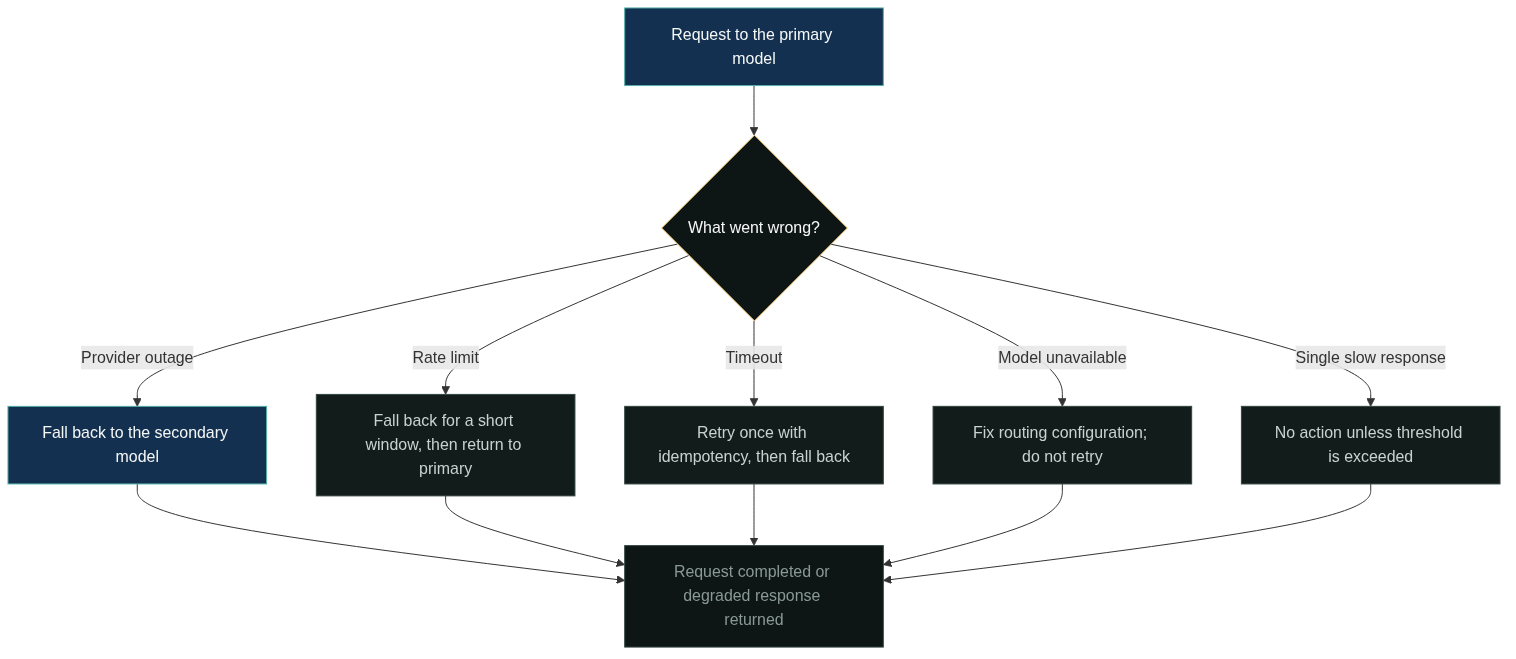
The trigger is the most important design decision, because it defines what counts as a failure. The common cases are provider outage, rate limit, timeout, and model unavailable.
A provider outage means the model endpoint returns errors for everyone, not just for your traffic. Fallback is clearly correct here: continuing to hammer the failing endpoint wastes time and money. A rate limit is different, because the provider is healthy but your account is over its quota. The right response is usually to fall back for a short window, then return to the primary, rather than treating the limit as a permanent condition. A timeout means the endpoint accepted the request but did not answer in time; this is the trickiest trigger, because a slow request can still complete after you have given up, which risks double-processing on retry. Model unavailable is a configuration-level failure, such as a model that was deprecated or not enabled for your account; the fix is usually a permanent routing change, not a runtime fallback.
The production rule of thumb is to trigger fallback on hard evidence, such as HTTP 5xx responses, repeated rate-limit errors, or a timeout after a defined interval, and to avoid triggering on single slow responses without a threshold.
Primary and Secondary Models
The core unit of a fallback design is the model pair: a primary model that handles normal traffic and a secondary model that takes over when the primary fails. The pair is chosen so the secondary can serve the same request types at an acceptable quality, even if the answers are weaker or more expensive.
Three rules make pairs work in production. First, the secondary should be genuinely independent, ideally a different provider, so a provider-wide outage does not take down both models at once. Second, the secondary needs a defined quality floor: a fallback that returns low-quality answers for hours is only slightly better than an outage. Third, the pair should be tested under real failure conditions, because the first time the secondary runs should not be the first real incident.
Designing Fallback Priority
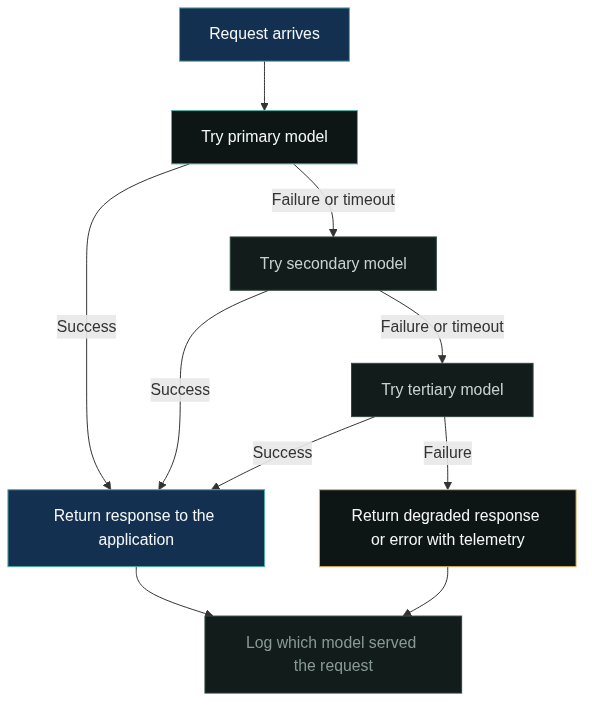
Fallback priority is the order in which models are tried. Most setups use a chain: primary first, then secondary, then tertiary, with a final degraded response or error state if every model fails.
Keep the chain short. Each extra hop adds latency and cost to a request that is already in trouble, so a chain of three models is usually the practical ceiling. The priority order should reflect both quality and operational goals: the best model that is likely to be available first, then the best independent alternative, then the cheapest acceptable option. The chain is also a place to encode policy, such as never falling back to a provider that cannot meet data requirements.
Retry Risks
Retries are the part of fallback that most often backfires. A retry can save a request that failed on a transient blip, but it can also amplify a real outage into a self-inflicted one.
The main risk is the retry storm. When many requests fail at once, a naive retry policy multiplies the load on an already struggling provider and on your own infrastructure. The standard mitigations are a strict retry budget, such as one retry per request, and a jittered backoff so retries do not arrive in synchronized waves.
The second risk is duplicate processing. If the primary model actually completed the request but the response was lost in transit, a retry can run the same generation twice, which matters for side-effectful calls such as billing or content moderation. The mitigation is idempotency: the request carries an identifier, and both the primary and fallback paths check it before acting. The same discipline applies to fallbacks in general, not just retries.
Cost and Quality Trade-Offs
Fallback changes the economics of a request, and the change is not always upward. A fallback to a flagship model can cost more than the primary, and a fallback to a cheap model can save money while degrading quality. Both directions need a conscious decision.
The usual pattern is to keep quality for user-facing features and accept a quality drop only for internal or low-stakes traffic. That split belongs in the fallback policy, not in the model list: the same chain can route differently depending on request type. The cost side also needs visibility. Teams should log which model actually served each request, because a fallback that fires often is effectively the new primary, and the budget should reflect reality. Failover documentation from managed routing services describes similar patterns for request routing and fallback behavior [3][4].
Production Checklist
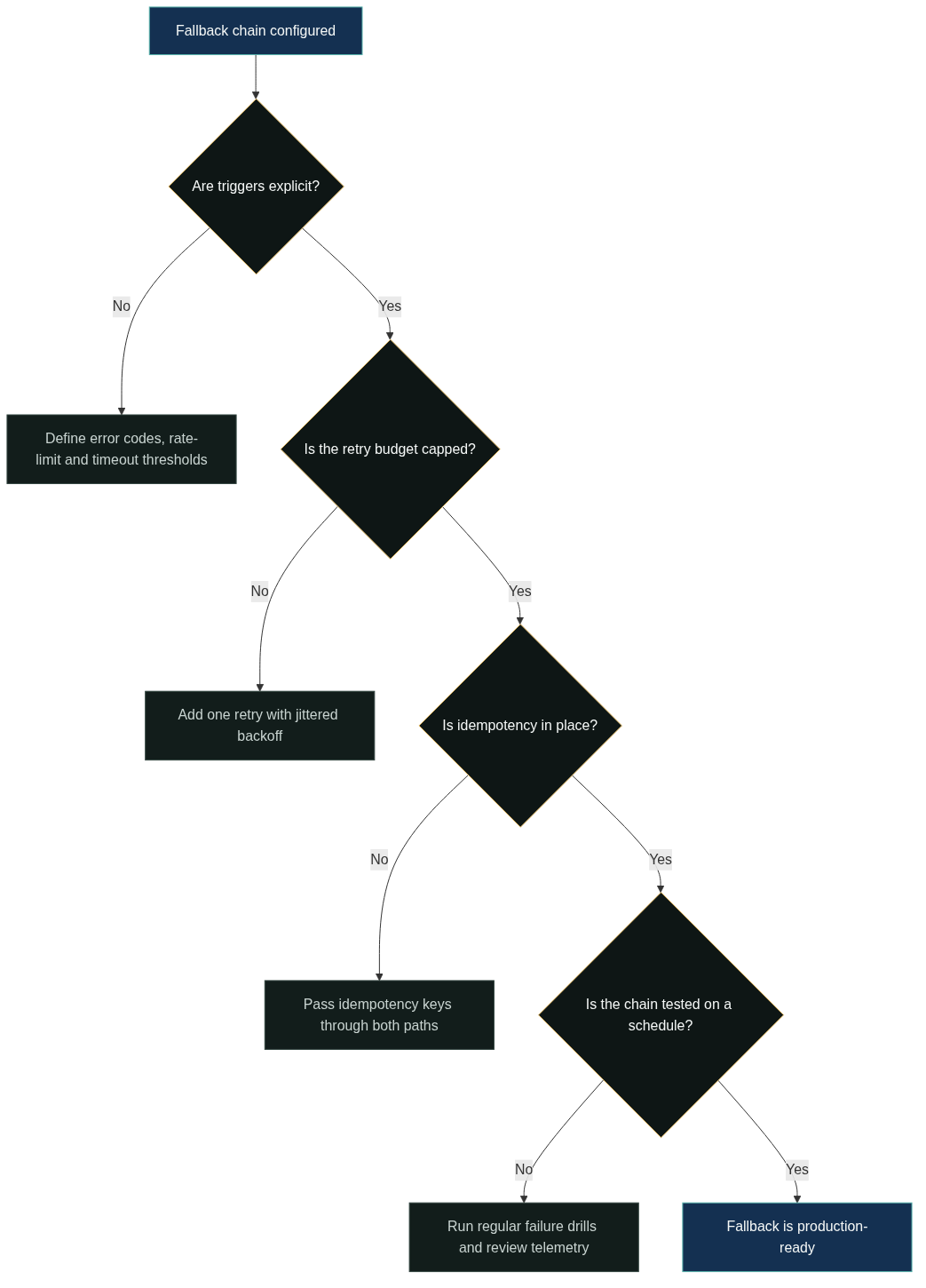
A fallback setup is ready for production when the following checklist holds:
- Every model in the chain is independently provisioned and can handle the request types it may receive.
- Failure triggers are defined explicitly: which error codes, rate-limit responses, and timeout thresholds count as failure.
- The retry budget is capped, with jittered backoff, so a provider outage cannot turn into a retry storm.
- Idempotency keys are passed through the primary and fallback paths to prevent duplicate processing.
- The chain is short, usually primary plus one or two fallbacks, and its priority order is documented.
- Telemetry records the served model, trigger reason, and latency per request, so fallback behavior is auditable.
- The fallback path is exercised on a schedule, not only during incidents, because an untested chain is a guess.
- A degraded mode exists for the case where every model fails, with a clear response and an alert.
Building a resilient multi-model setup? Read the docs to understand routing layers, model access, and how requests flow through one OpenAI-compatible endpoint.
FAQ
References
OpenAI. “Models overview.” https://platform.openai.com/docs/models. Public model catalog describing capability, speed, and usage differences across models.
Anthropic. “Models overview.” https://docs.anthropic.com/en/docs/about-claude/models/overview. Public documentation on selecting among Claude models by capability and cost.
LiteLLM. “Routing.” https://docs.litellm.ai/docs/routing. Public documentation on routing requests and fallback behavior across models.
OpenRouter. “Documentation.” https://openrouter.ai/docs. Public documentation of a managed LLM routing service and its model selection options.
Amazon Web Services. “Inference profiles for Amazon Bedrock.” https://docs.aws.amazon.com/bedrock/latest/userguide/inference-profiles.html. Public documentation describing routing to foundation models by region and workload.