

What Is a Routing Strategy?
A routing strategy is the decision logic that tells an LLM router which model should handle each request. The same router can behave very differently depending on the strategy it runs: one setup may optimize every call for price, another may protect response time, and a third may enforce hard policy rules before any model is considered. Choosing the right LLM routing strategy matters more than the router itself, because the strategy determines what trade-offs your application makes on every request.
A strategy is a repeatable rule or scoring method that converts request context into a model choice. Two ideas anchor every strategy. First, the strategy must have a goal, such as staying under a cost target or holding a latency budget, because a strategy without a goal has no way to judge a decision. Second, the strategy must be measurable, because teams tune routing by comparing outcomes, not by intuition. Model catalogs and provider documentation are a useful starting point for understanding the raw differences in price and speed that strategies exploit [1][2]. This guide assumes you already know what an LLM router is; if not, the pillar guide to the LLM router covers the basics first.
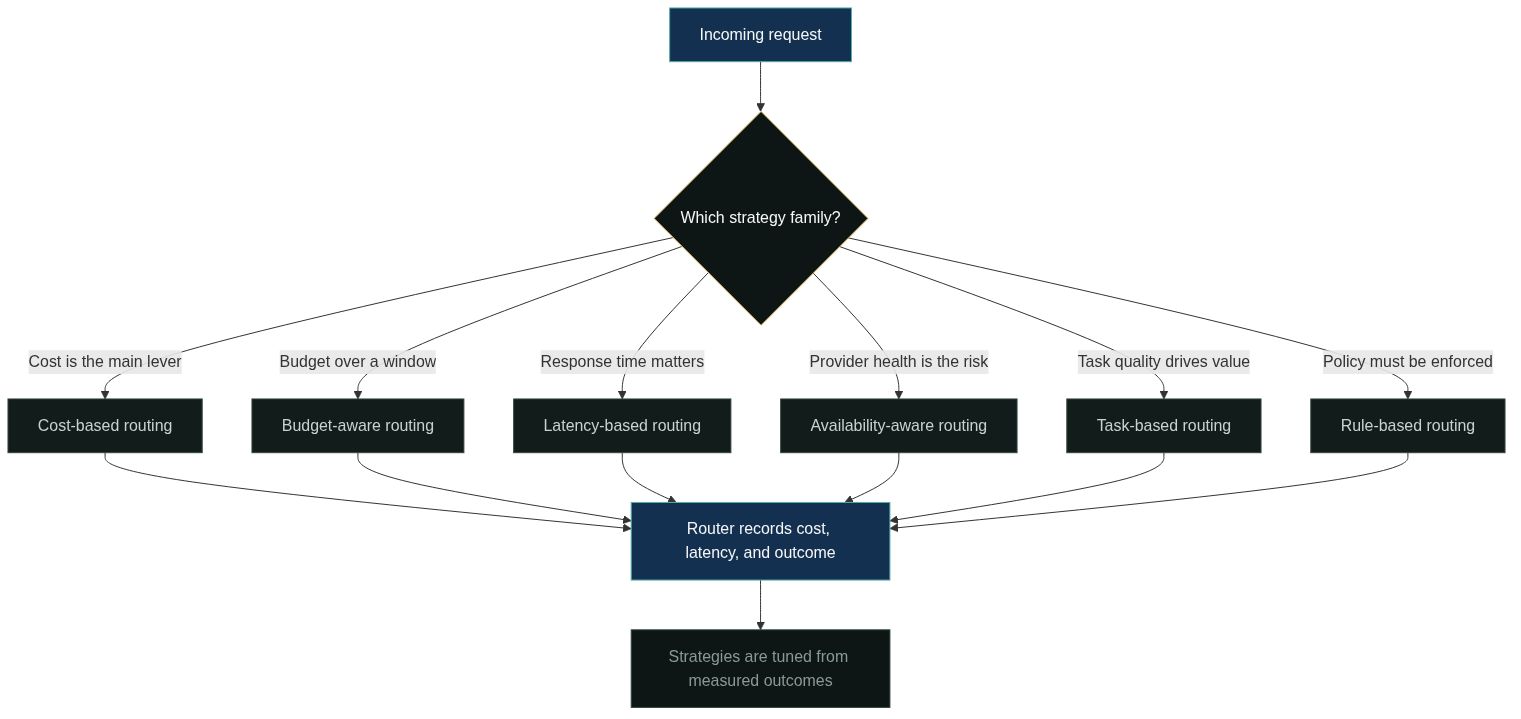
Cost-Based Routing
Cost-based routing sends each request to the cheapest model that can still satisfy the task. The strategy reads the price per token of each candidate model and picks the lowest-cost option that meets a minimum quality bar.
This strategy shines when request volume is high and many requests are simple. A support assistant answering routine questions can route most traffic to an inexpensive model and reserve expensive models for the small share of difficult cases. The failure mode is equally clear: if the quality bar is not enforced, cost-based routing quietly degrades answers. Teams should define what good enough means per task type, not per request, and audit samples of routed output regularly.
Latency-Based Routing
Latency-based routing optimizes response time, typically for interactive traffic where a slow answer breaks the experience. The router compares expected response time per model and prefers the fastest option for the request type.
Interactive chat, autocomplete, and voice-facing flows are the natural fit, because users notice delay in seconds. The catch is that latency varies over time, so a strategy based on static assumptions goes stale. The router needs recent measurements of each provider’s response time, which means the strategy only works when telemetry is collected from the start. It also pairs poorly with quality-only goals: the fastest model may be the weakest one, so latency-based routing usually needs a floor on task capability.
Availability-Aware Routing
Availability-aware routing watches provider health and routes traffic away from models that are failing, rate-limited, or degraded. It answers a simple question: which model is actually usable right now?
This strategy matters most for production workloads where a provider outage is a real risk. The router tracks error rates and status signals, and when a primary model misbehaves, traffic shifts to a healthy alternative. Availability-aware routing overlaps with fallback, but the two are not the same: fallback reacts to a failed request, while availability-aware routing tries to avoid the failure in the first place by routing around a sick provider. The mechanics of reacting to failures are covered separately in the guide to LLM fallback; here the focus is on prevention.
Task-Based Routing
Task-based routing classifies the kind of work in a request and sends it to the model strongest at that task. The router labels the request as code, chat, extraction, reasoning, or something else, and applies a per-task mapping.
This is the strategy teams most often build first, because it matches how products actually use models: different features have different quality needs. The hard part is the classifier. Rules work for narrow request shapes, such as routing anything that contains a code block to a coding model, while broader labels need a model-based classifier whose own errors must be monitored. Task-based routing also needs a maintenance habit, because models change over time and a mapping that made sense last quarter may not hold.
Budget-Aware Routing
Budget-aware routing adds a financial constraint on top of other signals. Instead of optimizing cost per request in isolation, it manages cost over a window: a daily or monthly budget is allocated across requests, and the router spends more per request where the business value is higher.
The practical pattern is tiering. A product defines budget tiers, classifies requests into tiers, and routes tier-one traffic to cheaper models while allowing tier-three requests to use flagship models. Budget-aware routing fixes a real weakness of plain cost-based routing, which can starve important requests of quality just because they happen to be cheap to serve. The trade-off is complexity: budgets need owners, and teams need dashboards that explain where the money went, otherwise the constraint becomes a black box.
Rule-Based Routing
Rule-based routing applies explicit, human-readable conditions: if a request matches a rule, send it to a fixed model. Rules can reference request attributes such as endpoint, user segment, data type, or region.
The strength of rule-based routing is auditability. Every decision can be traced to a rule, which makes it the default choice when compliance or policy is involved, such as keeping certain customer data away from specific providers. Its weakness is coverage: rules only handle what someone wrote down, so edge cases fall through to a default, and rule sets grow harder to maintain as they accumulate. Teams should treat rules as the safety layer of a routing setup, not as the entire strategy.
Static vs Dynamic Routing
Static routing fixes the model choice at deploy time: the mapping between request types and models is constant until someone changes the configuration. Dynamic routing re-evaluates choices per request using current measurements, such as live cost, latency, and availability data.
Static routing is simple, predictable, and cheap to operate, which makes it a good starting point for small workloads. It degrades when conditions change, because a mapping tuned for one cost or latency regime is blind to the next. Dynamic routing adapts continuously and can exploit short-lived differences between providers, but it depends on telemetry, adds decision latency, and is harder to debug. Many production setups run a hybrid: static rules for hard constraints and dynamic scoring for the choices where conditions actually vary.
Combining Multiple Routing Signals
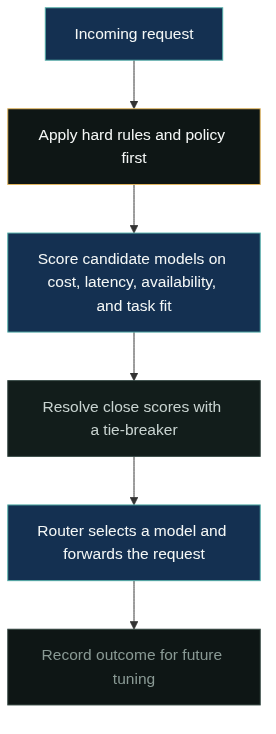
Real-world routing rarely uses one signal alone. The common pattern is a pipeline: first apply hard constraints, then score the remaining candidates, then apply a tie-breaker.
Hard constraints come first. Policy rules, such as data region or banned providers, are evaluated before any optimization, because they are not preferences. Next, the router scores candidates on the active signals, such as cost within a budget, latency under a target, and a minimum task capability. Finally, a tie-breaker decides between models that score closely. The order matters: putting cost scoring before policy rules would violate compliance, while putting latency before hard constraints could route to a banned provider.
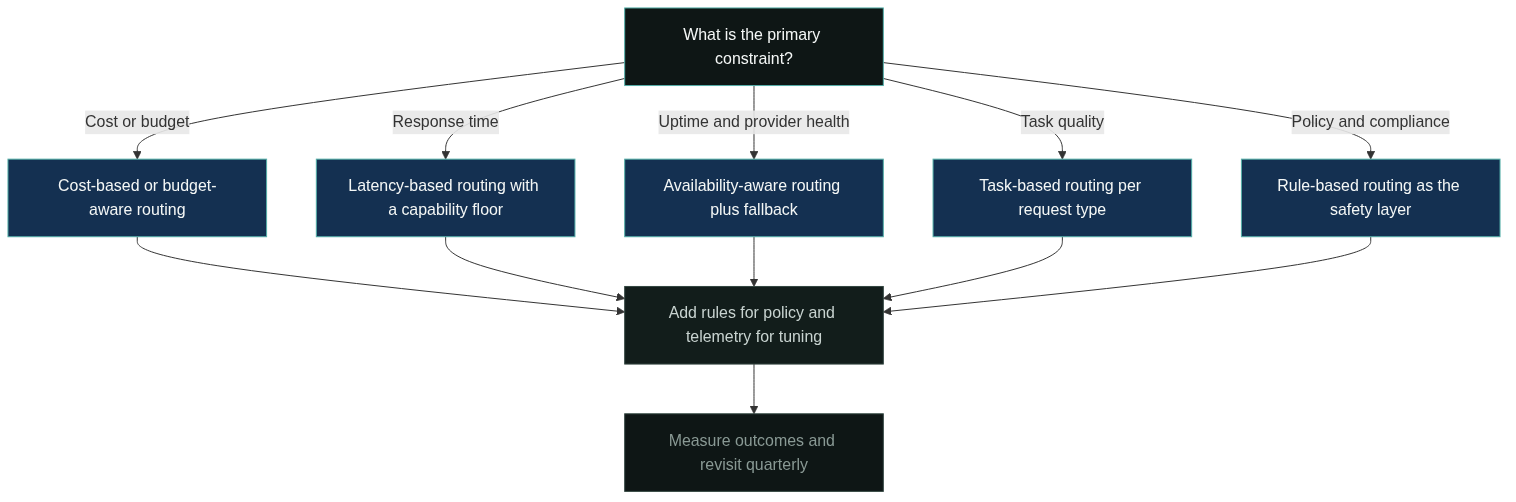
Choosing a Strategy for Your Scenario
The right strategy depends on the business scenario, and the differences are visible in a few common cases.
- High-volume internal tools usually start with cost-based or budget-aware routing, because the biggest lever is the bill.
- User-facing chat and assistants usually lead with latency and task-based routing, because response time and answer quality drive retention.
- Production APIs with hard uptime requirements need availability-aware routing plus fallback, because a provider outage is an operational event.
- Regulated or multi-region workloads start with rule-based routing, because policy compliance outranks every other signal.
- Early-stage products often do fine with static routing until request volume and traffic mix justify dynamic scoring.
The theme across these cases is that strategies are not mutually exclusive. Most teams combine two or three: rules for policy, a primary signal for the main goal, and a secondary signal for the next constraint.
Ready to put a routing strategy behind one endpoint? Read the docs to understand routing layers and pricing, then explore the models available for your workload.
FAQ
References
OpenAI. “Models overview.” https://platform.openai.com/docs/models. Public model catalog describing capability, speed, and usage differences across models.
Anthropic. “Models overview.” https://docs.anthropic.com/en/docs/about-claude/models/overview. Public documentation on selecting among Claude models by capability and cost.
LiteLLM. “Routing.” https://docs.litellm.ai/docs/routing. Public documentation on routing requests and fallback behavior across models.
OpenRouter. “Documentation.” https://openrouter.ai/docs. Public documentation of a managed LLM routing service and its model selection options.
Amazon Web Services. “Inference profiles for Amazon Bedrock.” https://docs.aws.amazon.com/bedrock/latest/userguide/inference-profiles.html. Public documentation describing routing to foundation models by region and workload.