

# Best LLM for Coding in 2026: Which Models Should Developers Use?
Choosing a coding model is not the same problem it was two years ago. Search for “best llm for coding” and you will find leaderboards with a clear winner at the top — then open your editor, run the same model on your own repository, and wonder why the experience does not match the headline number. That gap is not an accident, and it is not a marketing failure. It is the result of treating “coding” as one task when it is really a family of very different jobs.
This guide takes a task-based approach. Instead of declaring a single model the best LLM for coding, it breaks the question into the work a developer actually does — generating code, fixing bugs, refactoring, explaining, writing tests, understanding a large repository, and driving an agent — then maps each task to the model families that currently lead, with the version, provider, and last-reviewed date recorded for every claim. You also get a repeatable method to test models on your own stack, because the only benchmark guaranteed to match your experience is the one you run yourself.
Last reviewed: September 2026. Model versions, prices, and context windows change quickly. Every number below carries a date and an evidence tier (A = own testing, B = official docs, C = third-party benchmark). Re-verify anything time-sensitive against the official pages before you build on it.
There Is No Single “Best LLM for Coding” — There Is a Best Model Per Task
The search trap: developers want one winner, but no single model tops every coding task
The phrase “best llm for coding” implies a single answer. In practice, the models that lead one kind of coding work are often the wrong choice for another. The model that scores highest on a software-engineering benchmark may be too slow and too expensive for inline completion, while a cheaper model that handles most routine work well will struggle on a large, unfamiliar codebase.
This is not a subtle point. Serious comparisons of coding models in 2026 converge on the same observation from different angles: SWE-bench, Terminal-Bench, and LiveCodeBench do not disagree because one is broken — they measure genuinely different jobs, and the “best” model changes when the benchmark changes [1][2]. A single leaderboard position cannot tell you which model fits your project.
A model that leads SWE-bench can be too heavy, slow, and costly for everyday completion — and a cheap model may cover most routine work
The practical consequence is a trade-off most developers feel immediately. The frontier models that top agentic coding benchmarks are priced and provisioned for complex, multi-step reasoning. Using them for every autocomplete keystroke or “explain this function” request is overkill in both latency and cost. In many teams, a large share of daily coding work — completion, straightforward generation, explanation, boilerplate tests — does not need frontier reasoning at all [3]. A cost-efficient model can cover that routine workload, leaving the expensive model for the tasks where its capability actually pays off.
This guide’s method: split by coding task, compare on verifiable dimensions, and show you how to validate on your own stack
So instead of declaring one overall winner, this article does three things:
- Splits coding into concrete tasks — generation, completion, bug fixing, debugging, refactoring, explanation, test generation, repository/long-context understanding, and agentic coding.
- Compares models on verifiable dimensions — coding quality, instruction following, error rate, long-context handling, tool/agent capability, speed, input/output price, context window, and API availability — with each data point tied to an evidence tier and a date.
- Shows you how to validate a model yourself — the same prompt, the same code task, the same success criteria — so you are not buying on a headline score.
What We Compared and How to Read the Numbers
The models and exact versions reviewed (name, version, provider / API), each with a last-reviewed date
This comparison covers the models most relevant to coding work as of September 2026. Versions matter: a model family name without a version number is meaningless when new releases change behavior and benchmarks within months. Context-window figures below are Tier B/C (official docs and third-party catalogs) and were re-verified in September 2026.
| Model | Version / API name | Provider | Context window | Evidence tier | Last reviewed |
|---|---|---|---|---|---|
| Claude Sonnet 4.5 | claude-sonnet-4-5 |
Anthropic | 200K (1M beta for coding/agentic) | B/C | Sep 2026 |
| GPT-5.2 | gpt-5.2 |
OpenAI | 400K | B/C | Sep 2026 |
| Gemini 3 Pro | gemini-3-pro |
1M | B/C | Sep 2026 | |
| DeepSeek V3.2 | deepseek-v3.2 |
DeepSeek | ~164K | C | Sep 2026 |
The Claude Sonnet 4.5 200K standard window with a 1M beta option for coding and agentic work is documented by Anthropic and third-party catalogs [4][5]. GPT-5.2’s 400K context window is confirmed by OpenAI’s model documentation as reported by multiple catalogs [6][7]. Gemini 3 Pro’s 1M-token context is confirmed on Google’s official Gemini API pricing page [8]. DeepSeek V3.2’s ~164K window is documented on OpenRouter [9].
Note on recency. The frontier moves fast — newer releases (for example a later Claude Sonnet or Gemini Pro generation) may have shipped since this review. Treat the version column as the exact thing you are reading about, and confirm the latest available version on the provider’s page before integrating.
The comparison dimensions: coding quality, instruction following, error rate, long-context handling, tool/agent capability, speed, input/output price, context window, API availability
These ten dimensions are what actually separate models in real coding work. They are not all equal for every task, which is why this guide pairs each task with the dimensions that matter most for it. Coding quality and instruction following drive generation and refactoring; error rate and root-cause tracking drive bug fixing and debugging; context window and retrieval drive repository understanding; tool-call reliability and speed drive agentic work; input/output price and latency drive completion and high-volume explanation [3].
Evidence tiers used in this article — A (own testing), B (official docs/pricing), C (third-party benchmarks) — and why third-party data is never presented as our own test
Every claim in this article is labeled with where it comes from:
- Tier A — data from our own testing. This article includes no Tier A data: we did not run a controlled side-by-side test across these models before publishing. Where we describe a testing method, it is a method for *you* to run, not a claim that we already ran it.
- Tier B — official model documentation and pricing pages.
- Tier C — third-party benchmarks and aggregators (SWE-bench, LiveCodeBench, Vellum, Artificial Analysis, and similar).
This matters because third-party scores are frequently misread as someone’s own test. They are not. A benchmark number is a measurement taken under a specific harness and configuration [1]; it is evidence about the model under those conditions, not a guarantee of how it will behave in your codebase. We keep the tiers explicit so you always know which kind of evidence supports a claim.
Why a Single Benchmark Can’t Answer “Which Is Best”
What SWE-bench Verified, LiveCodeBench, and Aider Polyglot each actually measure — different tasks, different methodologies
The coding benchmarks you will see cited most are not interchangeable:
- SWE-bench Verified measures whether a model can resolve real GitHub issues end-to-end inside a repository. It is a human-filtered subset of 500 instances drawn from real Python open-source projects, run with an agent harness. In short, it tests *agentic software-engineering ability*, not raw code generation [10][2].
- LiveCodeBench is a contamination-free benchmark that continuously collects new competitive-programming problems after a model’s training cutoff, so results cannot be gamed by memorized answers. It tests code generation plus related skills like self-repair, code execution, and test-output prediction on fresh problems [11].
- Aider Polyglot tests the ability to edit existing code across multiple languages — a different skill from writing code from scratch.
These are three different jobs. Writing a function, fixing a repository, and editing existing code across languages are not the same task, so comparing their scores without comparing their methods tells you little [1].
HumanEval is saturated and no longer separates frontier models; LiveCodeBench filters contamination by training cutoff
The classic code-generation benchmark HumanEval is now largely saturated: frontier models have pushed pass@1 scores so high that the benchmark no longer separates current models and is mostly used as a sanity check [12][13]. That is precisely why contamination-free, methodology-aware benchmarks like LiveCodeBench exist — they keep collecting fresh problems and filter by training cutoff, so a model cannot inflate its score by having seen the answer during training [11][13].
The takeaway: compare methodologies before comparing scores; no one leaderboard maps to your specific project
When you read a “best llm for coding” score, the first question is not “which model won” but “what task did this benchmark actually test, and under what harness?” A model that tops an agentic repository-fixing benchmark may not be the fastest or cheapest for editor completion, and vice versa [1][3]. No single leaderboard is built around your project’s mix of tasks, context, and constraints — which is why the rest of this guide gives you a task-by-task view and a way to test on your own code.
Task-by-Task: Which Model Families Lead (as of Last Reviewed)
The following is directional, not a promise: it reflects third-party benchmark data and aggregator observations as of September 2026. In each case the underlying source is a third-party measurement or an explicitly labeled aggregator/community observation, never our own test.
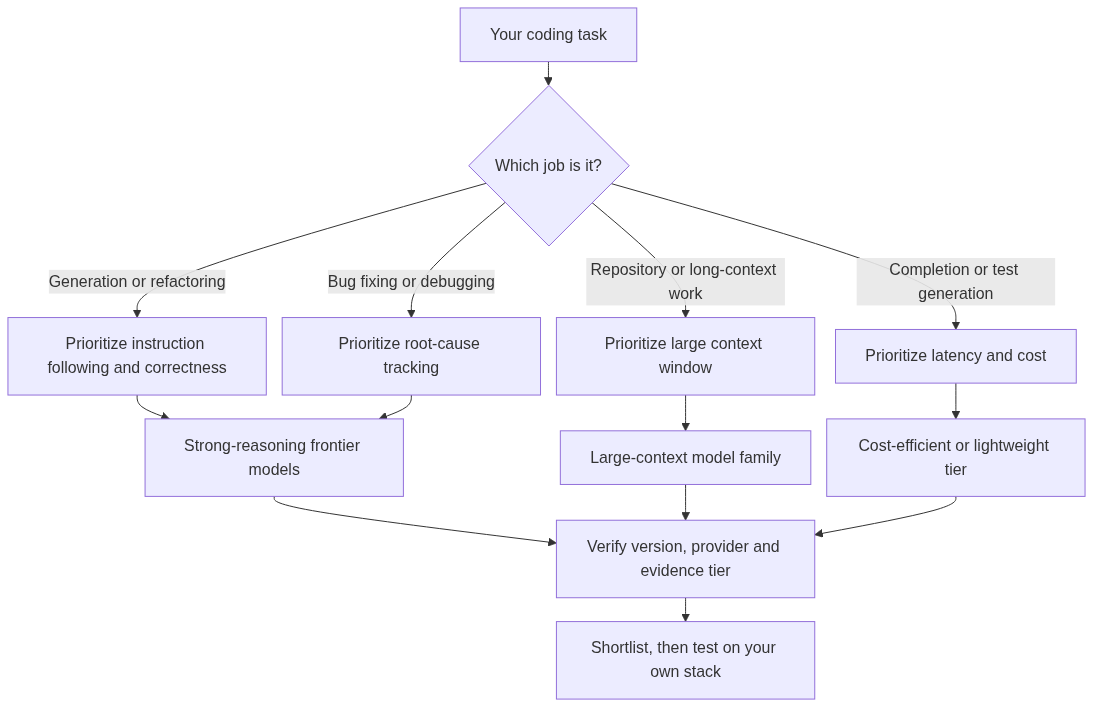
Code generation & refactoring — strong-reasoning models and what the data supports
For generating new code from a clear requirement and for refactoring existing code while preserving behavior, the strong-reasoning frontier models lead agentic software-engineering benchmarks. On SWE-bench Verified, the top agentic-coding tier as of the last-reviewed date includes Claude Sonnet 4.5 (77.2%, rising to 82.0% with parallel test-time compute) and GPT-5.2 (around 80%), placing both at the top of the table [14][15][16]. Gemini 3 Pro scores 76.2% on the same benchmark, within a few points of the leaders [17]. For refactoring specifically, the differentiating factors are instruction following and the ability to keep semantics intact across a change — capabilities these reasoning models demonstrate, though the same job is often well within reach of mid-tier models on smaller, well-scoped changes.
Bug fixing, debugging & code explanation — root-cause work vs. read-and-summarize work
For bug fixing and debugging, the models that lead agentic software-engineering benchmarks — because they can navigate multiple files and reason about root causes end-to-end — are the natural candidates, an assessment based on third-party agentic-coding results rather than a single-vendor claim [10][2]. Code explanation is a different story: because it is a read-and-summarize task rather than a reasoning-heavy edit, cheaper models routinely handle it well. If your workload is mostly “explain this code” or “why does this fail,” you can often satisfy it without paying frontier pricing [3].
Repository / long-context understanding & agentic coding — large-context and tool-call reliability
For understanding and modifying a large repository, context window becomes the binding constraint. Gemini 3 Pro offers a 1M-token context window, which is why it is frequently cited for everyday coding inside large codebases where you need substantial context in a single request [17][8]. For agentic coding — where the model must call tools, keep state across many steps, and fix issues end-to-end — the leading candidates are the models that top SWE-bench Verified (Claude Sonnet 4.5 and GPT-5.2) [14][15][16]. In agentic scenarios, what matters most is tool-call reliability over many turns, not a single headline score.
Code completion & test generation — latency, throughput, and cost-driven choices
Code completion is dominated by latency and throughput, not by benchmark reasoning scores. The best completion model is the one that returns a correct suggestion fast enough to stay out of your way [3]. For high-volume, latency-sensitive completion and for test generation, cost-efficient models such as DeepSeek V3.2 are often the pragmatic pick: they carry a fraction of the frontier price while covering a large share of routine generation and test-writing work [9]. Test generation in particular rewards instruction following and coverage understanding more than deep multi-step reasoning, so a mid-tier or cost-tier model is frequently sufficient.
Benchmark Scores Do Not Equal Your Development Experience
Test contamination, static-output harnesses vs. dynamic agent runs, and evaluation environment gaps
Three mechanisms explain why a leaderboard position can disagree with your experience. First, test contamination: a model trained on benchmark problems can score higher than its real ability, which is why contamination-free benchmarks exist [11]. Second, static vs. dynamic evaluation: many benchmarks score a single static output, while real agentic work is a dynamic, multi-turn process where the model must act on intermediate results [13]. Third, environment gaps: a benchmark runs in a controlled sandbox with a fixed harness, not inside your IDE, your build system, and your repository’s conventions [10][1].
Why a leaderboard leader can feel different inside your IDE, repo, and toolchain
Even a perfectly measured benchmark is measured in a different environment from the one you develop in. Your codebase has its own idioms and dependencies; your toolchain imposes its own context limits and prompt shapes; your latency budget and cost tolerance differ from a benchmark’s [13][3]. A model that leads under a research harness can feel slow, verbose, or inconsistent when wired into your actual workflow.
The practical implication: treat leaderboards as directional signal, not a purchase decision
None of this means benchmarks are useless. It means they are directional: they tell you which model families are strong on which kinds of tasks, so you can shortlist candidates [1][3]. The final decision belongs to a test you run on your own code, under your own constraints — which is exactly what the validation method below is for.
Pricing × Performance: Finding the Right Tier for Your Workload
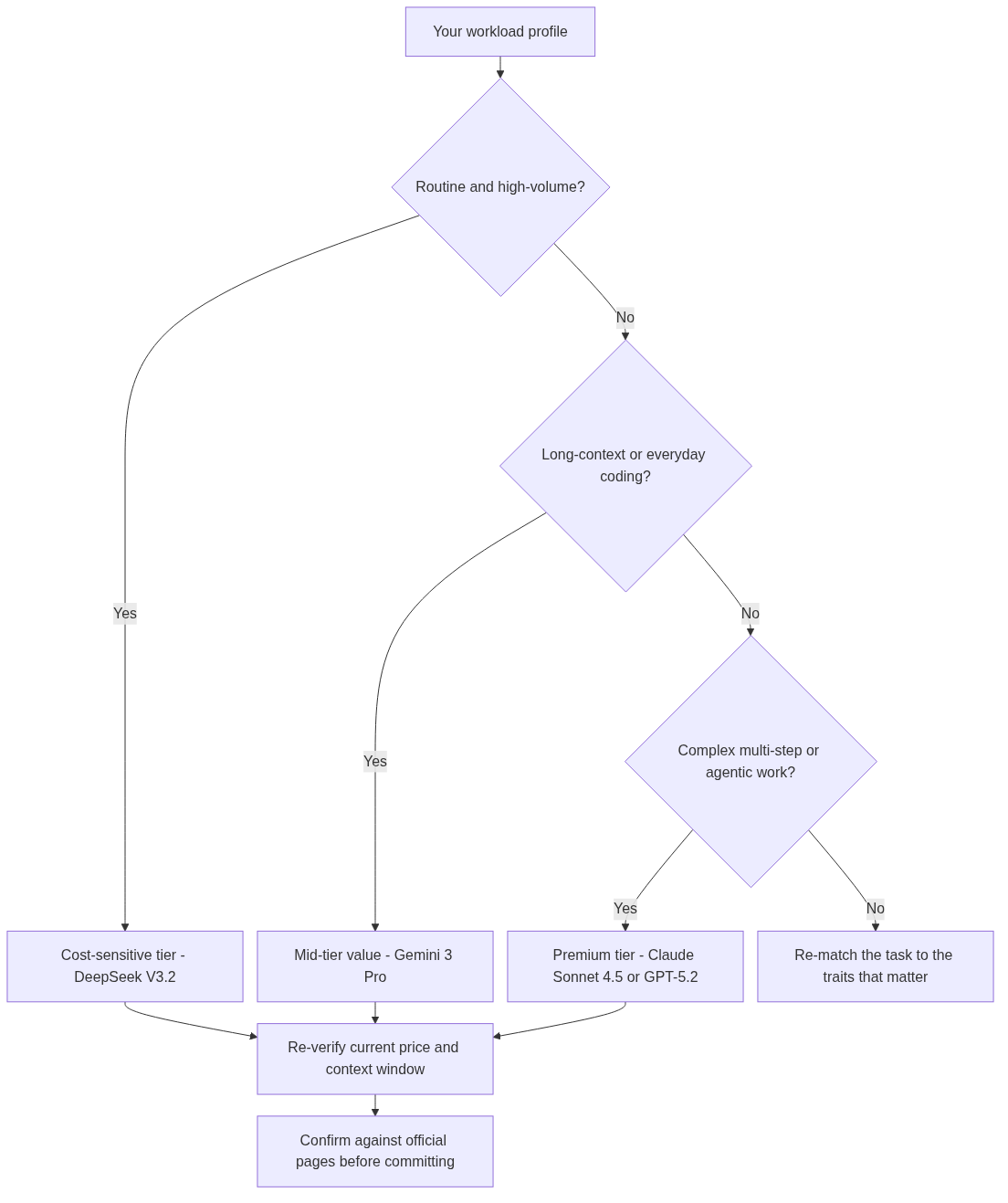
Prices and context windows below are as of September 2026 (Tier B/C) and are high-volatility fields — always re-verify against official pricing pages before you commit.
| Tier | Example model | Input / Output $ per 1M tokens | Context | Best suited for |
|---|---|---|---|---|
| Cost-sensitive / high-throughput | DeepSeek V3.2 | ~$0.21 / ~$0.31 (OpenRouter) | ~164K | Batch completion, code explanation, test generation, high-volume routine work [9] |
| Mid-tier value | Gemini 3 Pro | ~$2.00 / ~$12.00 (preview) | 1M | Long-context and everyday coding across large repos [17][8] |
| Mid-high general | GPT-5.2 | $1.75 / $14.00 | 400K | Fast prototyping and general coding [6][7] |
| Premium / agentic | Claude Sonnet 4.5 | $3.00 / $15.00 | 200K (1M beta) | Complex coding and coding agents [4][5] |
Note on price sources. Prices in this table are Tier B/C and were captured in September 2026. GPT-5.2’s $1.75 input / $14.00 output pricing and 400K context are documented directly on model catalogs [6][7]. Claude Sonnet 4.5’s $3 / $15 pricing is confirmed by Anthropic’s official announcement [5]. Gemini 3 Pro preview pricing and DeepSeek V3.2 OpenRouter pricing are third-party snapshots [17][9]. None of these should be treated as stable — verify before you commit.
Cost-sensitive / high-throughput tier (e.g., DeepSeek V3.2) — batch completion, explanation, test generation
DeepSeek V3.2, at roughly $0.21 per million input and $0.31 per million output tokens on OpenRouter with a ~164K context window, is representative of the cost-efficient tier that makes high-volume work economically sensible [9]. If you are generating tests across a large codebase, explaining many functions, or running batch completion, this tier can cover the workload at a small fraction of frontier cost.
Mid-tier value (e.g., Gemini 3 Pro) — long-context and everyday coding
Gemini 3 Pro’s 1M-token context window makes it well suited to everyday coding inside large repositories, where you need the whole codebase in context rather than deep multi-step reasoning on a small problem [17][8].
Premium / agentic tier (e.g., GPT-5.2, Claude Sonnet 4.5) — complex coding and coding agents
For complex, multi-file coding and for driving coding agents, the premium-tier models that top SWE-bench Verified are the current leaders: Claude Sonnet 4.5 at $3 / $15 and GPT-5.2 at $1.75 / $14 [6][5]. These carry the higher price but deliver the agentic and reasoning capability that simpler models lack [14][15][16].
Prices and context windows are high-volatility fields — always re-verify against official pages after the last-reviewed date
This tier table will be outdated quickly. Model releases, price changes, and context-window expansions happen on a monthly basis. Before you build pricing into a product decision, confirm the current numbers on the provider’s official page and re-check the model version you plan to use [8].
How to Validate a Coding Model on Your Own Stack
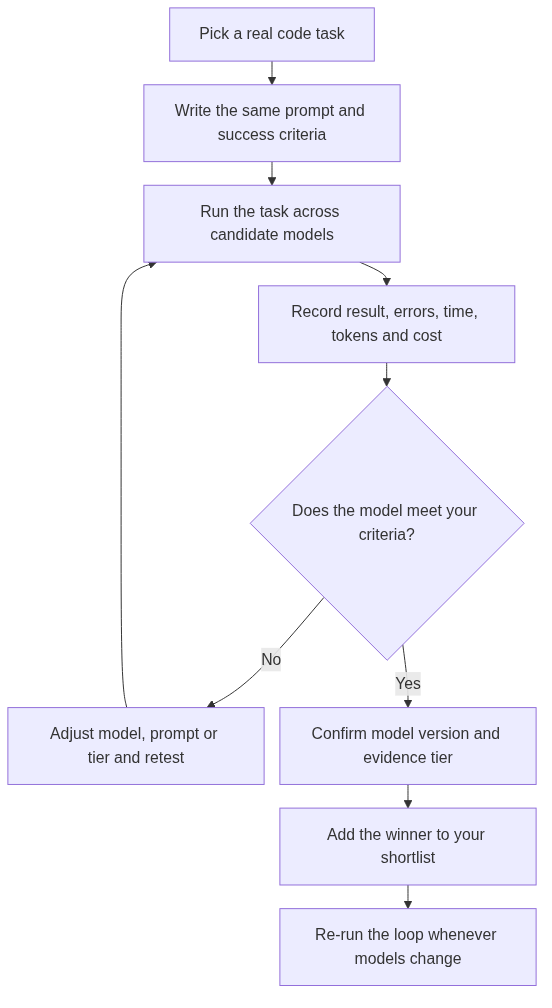
Because no leaderboard maps to your specific project, the reliable way to choose is to test the shortlisted models yourself. This section gives you a method that produces comparable results regardless of which model wins.
Build a repeatable test: the same prompt, the same code task, the same success criteria
The core discipline is consistency. Run every candidate model against the same prompt, the same code task, and the same success criteria. If you change the prompt between models, you are no longer comparing the models — you are comparing your prompts. Define success before you run: does the generated code pass the tests? Does the fix actually resolve the bug? Does the refactor preserve behavior?
Five concrete tests — generate a function, fix a bug, refactor code, generate tests, modify a long code context — and what to record per run
These five tests cover the range of real coding tasks and are easy to run on your own code:
- Test 1 — Code generation: Give a clear requirement and ask for a small function or component.
- Test 2 — Bug fixing: Provide code with a bug and ask the model to locate and fix it.
- Test 3 — Refactoring: Provide poorly written code and ask the model to refactor it and explain why.
- Test 4 — Test generation: Ask the model to write tests for an existing function.
- Test 5 — Long-context modification: Provide a longer code context and ask the model to understand and modify it.
For every run, record the same fields: model, version, prompt, result, whether the task succeeded, the major error if any, approximate response time if you can measure it stably, and token/cost if you can read it reliably. The point is to produce a table you can compare across models under identical conditions.
A coding-model selection checklist: classify the task, rank your priority (quality/latency/cost/context), verify versions and sources, and compare two or more complementary benchmarks
Before you send anything, run through a short checklist:
- [ ] Which class of coding task is this? (generation / completion / bug fix / refactor / explanation / test / long-context / agentic)
- [ ] What is my primary constraint — quality, latency, cost, or context length?
- [ ] Have I verified the exact model version and its last-reviewed date?
- [ ] Am I looking at two or more complementary benchmarks, not one leaderboard?
- [ ] Do I understand that a leaderboard lead is not the same as my project experience?
- [ ] Will I test with the same prompt, code task, and success criteria across models?
- [ ] Am I keeping clear which data is my own test (A), official (B), or third-party (C)?
API integration and switching considerations — OpenAI-compatible interfaces make side-by-side comparison low-friction
The final practical consideration is switching cost. OpenAI-compatible interfaces mean you can often swap the model name in a request without rewriting your application logic — an important detail when you want to run several models side by side on the same prompt. Testing different models under one interface, rather than wiring each into your app separately, keeps the comparison low-friction and makes it easy to switch when a model’s price, latency, or quality changes.
Final Selection Matrix and Next Steps
The task-based selection matrix: coding task → key capability → directional model family direction (as of last reviewed) with evidence tier
| Coding task | Key capability needed | Directional model direction (as of Sep 2026) | Evidence tier |
|---|---|---|---|
| Code generation (new code from a requirement) | Instruction following, correctness | Strong-reasoning models (GPT-5.2 / Claude Sonnet 4.5) | C |
| Code completion (in-editor) | Low latency, high throughput | Lightweight / fast or cost-tier model | B/C |
| Bug fixing & debugging | Root-cause tracking, file-level reasoning | Agentic front-runners (Claude Sonnet 4.5 / GPT-5.2) | C |
| Refactoring | Instruction following, preserving semantics | Claude Sonnet 4.5 / GPT-5.2 | C |
| Code explanation | Clear expression, low cost | Cost-tier model is often sufficient | C |
| Test generation | Coverage understanding, instruction following | Mid-tier or cost-tier model | C |
| Repository / long-context understanding | Large context, retrieval | Gemini 3.x (1M context) | B/C |
| Agentic coding | Tool-call reliability, long multi-step execution | Claude / Codex-style (OpenAI) families | C |
Each row is directional and tied to a date and a source tier. It is a starting point for your shortlist, not a guarantee for your project.
Bottom line: pick by task, then verify by running the same prompt across models through a unified API instead of buying on a single headline score
The takeaway from this whole comparison is consistent: pick by task, then verify. Identify the kind of coding work you do most, shortlist the model families that lead that task per the data above, and then run the same prompt, the same code task, and the same success criteria across your shortlist. Buy on the result of that test — not on a single benchmark headline that was measured in someone else’s environment.
Explore the GoModelHub model catalog and read the docs to test different models under one interface
If you want to run this comparison without wiring several providers into your application separately, GoModelHub offers one OpenAI-compatible API to access, switch, and manage multiple AI models — so you can test different models on the same prompt through a single interface and track token usage and cost in one place. Explore the model catalog to see what is available, or read the docs to set up your first request. For a broader decision framework that covers workloads beyond coding, our how to choose an LLM guide walks through the full selection method.
FAQ
Is there really no single best LLM for coding?
Correct. Coding is a family of different tasks — generation, completion, bug fixing, refactoring, explanation, test generation, long-context understanding, and agentic work — and no single model currently leads all of them. The model that tops an agentic software-engineering benchmark can be too slow and expensive for everyday completion, while a cheaper model handles most routine work well [1][3].
Which model is best for complex, multi-file coding in 2026?
As of September 2026, the strong-reasoning models that top SWE-bench Verified — Claude Sonnet 4.5 (77.2%, rising to 82.0% with parallel test-time compute) and GPT-5.2 (around 80%) — are the current leaders for complex and agentic coding [14][15][16]. These carry higher prices, so reserve them for the tasks that actually need that capability.
What is the best model for large repositories?
For large-repository understanding, context window is the binding constraint. Gemini 3 Pro offers a 1M-token context window, making it well suited to everyday coding inside large codebases where you need significant context in a single request [17][8].
What is the best model if I care most about cost?
For cost-sensitive workloads, DeepSeek V3.2 is representative of the cost-efficient tier, priced around $0.21 per million input and $0.31 per million output tokens on OpenRouter with a ~164K context window [9]. It is well suited to batch completion, code explanation, and test generation where frontier reasoning is not required.
Why do benchmark scores not match my real experience?
Three main reasons: test contamination (models trained on benchmark problems can over-score), static-output evaluation versus dynamic multi-turn agent work, and environment gaps between a controlled benchmark sandbox and your actual IDE, repository, and toolchain [11][1][13]. Benchmarks are directional signals, not a guarantee of how a model behaves in your project.
How should I test a coding model myself?
Run each candidate against the same prompt, the same code task, and the same success criteria. A useful set is: generate a function, fix a bug, refactor code, generate tests, and modify a long code context. Record model, version, prompt, result, whether it succeeded, major errors, response time, and token/cost per run.
What do the evidence tiers A, B, and C mean?
Tier A is data from your own testing, Tier B is official model documentation and pricing, and Tier C is third-party benchmark data. This article includes no Tier A data — it clearly separates official and third-party information so no third-party benchmark is ever presented as our own test.
Do prices and context windows stay stable?
No. Model prices, versions, and context windows change frequently — often monthly. Every number in this guide carries a last-reviewed date of September 2026, and you should re-verify anything time-sensitive against the provider’s official pricing page before building on it [8].
References
Coding LLM benchmarks explained — whatllm.org— explains that SWE-bench, Terminal-Bench, and LiveCodeBench measure different jobs and that “the best coding model changes when the benchmark changes.”
Vellum LLM Leaderboard— confirms that SWE-bench Verified measures agentic software-engineering ability on real GitHub issues and is used as the agentic-coding ranking signal.
Artificial Analysis model leaderboards— compares 250+ models across intelligence, price, speed, and context, supporting the argument that different dimensions separate models in different ways.
Claude Sonnet 4.5 on Anthropic — whichllm— confirms Claude Sonnet 4.5 at $3.00 input / $15.00 output per 1M tokens with a 1M-token context window.
Claude Sonnet 4.5 — Anthropic news— official Anthropic confirmation of Claude Sonnet 4.5 at $3 input / $15 output per 1M tokens.
GPT-5.2 on Azure — whichllm— confirms GPT-5.2 at $1.75 input / $14.00 output per 1M tokens with a 400K-token context window.
GPT-5.2 in production — EvoLink— cites OpenAI’s model documentation confirming GPT-5.2’s 400K context window and 128K max output tokens.
Gemini API pricing — Google AI for Developers— the official Google pricing page confirming the 1M-token context class for Gemini models.
DeepSeek V3.2 pricing and benchmarks — OpenRouter— confirms DeepSeek V3.2 at $0.2088 input / $0.3096 output per 1M tokens with a 163,840-token context window.
SWE-bench official leaderboards— defines SWE-bench Verified as a human-filtered subset of 500 real GitHub issue instances run with an agent harness, i.e., agentic software-engineering ability.
LiveCodeBench paper (arXiv 2403.07974)— the academic source describing the contamination-free evaluation methodology that continuously collects new problems and measures self-repair, code execution, and test-output prediction.
HumanEval benchmark explained — DemandSphere— documents that HumanEval is near-saturated and less useful for comparing frontier models, with LiveCodeBench and SWE-bench providing better discrimination.
Benchmark saturation in AI evaluation — mbrenndoerfer— explains why static metrics hit ceiling effects, lose statistical power, and why dynamic benchmarks solve this.
Claude Sonnet 4.5 model guide — c-ai.chat— reports 77.2% base SWE-bench Verified score rising to 82.0% with parallel test-time compute.
Anthropic claims best coding model with Claude Sonnet 4.5 — Decrypt— reports Claude Sonnet 4.5’s 77.2% SWE-bench Verified score rising to 82% with parallel compute.
GPT-5.2 tops Gemini 3 in AI benchmark game — The Decoder— reports GPT-5.2 at 80% on SWE-bench Verified (up from GPT-5.1’s 76.3%).
Gemini 3 Pro turns sparse MoE and 1M-token context into a practical engine — MarkTechPost— reports Gemini 3 Pro scoring 76.2% on SWE-bench Verified with a 1M-token context window.